Managing customer relationships effectively requires more than simply storing contact details and business records. Organizations using Microsoft Dynamics 365 CRM often manage complex networks of accounts, contacts, opportunities, stakeholders, and business relationships. Understanding how these records connect is essential for improving customer engagement, strengthening business relationships, and making informed decisions. Visual Dynamics 365 Relationship Mapping offers a smarter way to explore these connections by transforming traditional CRM data into an interactive visual representation.
Microsoft Dynamics 365 CRM provides powerful capabilities for managing customer information and tracking business interactions. However, when organizations handle multiple accounts, contacts, and related records, understanding the complete relationship structure can become challenging. Users may need to navigate through several record forms, related lists, and different sections to identify how business entities are connected. This traditional approach can consume valuable time and make it difficult to recognize important relationships.
Visual relationship mapping addresses this challenge by presenting CRM connections in an organized graphical format. Instead of viewing information only through conventional tables and forms, users can explore relationships through visual maps, interconnected nodes, and structured hierarchies. This approach makes complex CRM information easier to understand and allows employees to identify connections between different records more efficiently.

With Dynamics 365 relationship mapping, businesses can gain a clearer understanding of their customer ecosystem. Sales representatives can explore connections between accounts and contacts, identify important stakeholders, and better understand customer organizational structures. Account managers can use relationship visualization to gain additional context about their customers, while business development teams can explore connections that may help uncover new opportunities.
One of the key advantages of visual Dynamics 365 relationship mapping is improved data visibility. Customer information is often distributed across multiple CRM records, making it difficult to understand the complete picture through individual record views. A visual representation brings related information together, helping users explore how different records are associated. This can improve information discovery and reduce the time employees spend navigating between CRM screens.
Relationship mapping can also support better stakeholder management. In B2B environments, purchasing decisions frequently involve multiple individuals with different roles and responsibilities. Understanding these connections is important for sales teams that want to establish stronger customer relationships. By visualizing account and contact relationships, teams can gain a better understanding of organizational structures and identify the people involved in important business interactions.
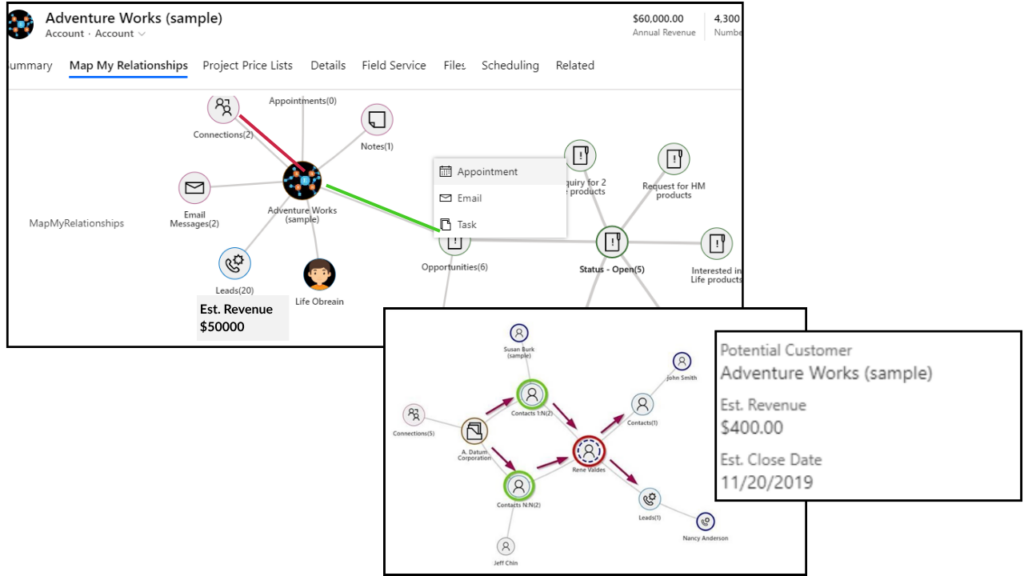
Another important benefit is simplified CRM navigation. Traditional Dynamics 365 views are useful for displaying structured information, but they may not always communicate complex relationships effectively. Visual relationship maps provide an intuitive alternative by displaying connected records in a graphical structure. Users can follow relationships, explore associated records, and understand how information is interconnected without relying entirely on manual navigation.
This is where Inogic's Map My Relationships application enhances the Microsoft Dynamics 365 CRM experience. The application helps users visualize relationships between Dynamics 365 CRM and Dataverse records through interactive mind maps and relationship views. Rather than navigating through multiple screens to understand connected business information, users can explore their CRM data through a visual interface.
Map My Relationships helps organizations turn complex CRM information into meaningful visual insights. Users can visualize account and contact relationships, explore related records, and understand connections within their business data. Its graphical approach makes relationship discovery more intuitive and supports employees who need a clearer understanding of customer information.
For sales teams, visual relationship mapping can make account research and customer engagement more effective. Representatives can gain a broader perspective of customer connections and use this information to prepare for meetings, understand stakeholders, and develop better engagement strategies. For managers, visual CRM relationships can provide additional context when reviewing customer accounts, business opportunities, and organizational connections.
The application is also useful for organizations working with Microsoft Dataverse and Power Apps. As business applications expand, the volume of interconnected records increases. Having a visual way to explore these relationships can help users understand their data more easily and improve the overall CRM experience.
Ultimately, visual Dynamics 365 relationship mapping is about making business information more accessible, understandable, and actionable. By moving beyond traditional CRM record navigation, organizations can gain a better perspective of their customer relationships and improve the way teams interact with business data.
If your organization wants to simplify CRM navigation, visualize customer connections, and gain better visibility into related records, explore Inogic's Map My Relationships. Discover how interactive relationship mapping can transform the way you explore Microsoft Dynamics 365 CRM and Dataverse data.
Comments